2013年8月25日星期日

Workshop2: Eating habits (correction)


Workshop 2 is using the food as a metaphor for the different countries’ education. In this essay, I will compare the food cultural from different countries and discuss the differences between Chinese and English education cultures. There are a lot of differences between China and Western countries, no matter in food or in education.

In this paragraph I will describe the differences between English and Chinese food. I had an opportunity to have lunch with Alexandra on Tuesday. We went to a restaurant called Jenny, which is same as my name. We ordered two traditional English foods, one is fish and chips, the other one was a whole big potato covered with cheese, called Jacket Potato. The platter was so big, I can hardly image that people can eat them all by just one person.  I got full quickly after I ate just half of the platter. Alexandra told me that potato was a common food material in English food, and there were actually a lot of fat in some English traditional food. To girls, maybe it is not a good choice. I also brought Chinese food to share with Alexandra which I cooked early that morning, fried rice with eggs and lettuce with oyster sauce. Although it was cold when we ate, I am glad that Alexandra liked my food. 
I think English food is easier and more convenient to take away, like the sandwich culture. I have seen plenty types of sandwiches in London. I like them, they are delicious and easy to make. But the cooking process for Chinese food is more complicated. Food you can take away for lunch called box rice in China, it is also more difficult to make than sandwiches. There are many steps to finish one box rice. But the balance of nutrition in food is healthy and less fat in food. However I like English and Chinese food both, It is a good experience to try different food types. I can change the food type everyday in London’s daily life.
The education is also quite different in two countries. In China, students almost do not have the chance to eat lunch or dinner with teachers. The relationship between students and teachers will not be this close, people are shy and unfamiliar with each other. Most students do not dare to question teachers or to suggest there can be a better way to do the projects. They just do what their teachers tell to do. The relationship between students and teachers is lack of communication. Students always feel uncomfortable to be alone with teachers in China. I like the relationship with tutors in London, which is quite different from China. Tutors here like to be questioned, like to discuss the every possibility about the projects with students. They encourage students to be more spontaneous and creative. (Sir K. Robinson, 2011) The atmosphere in class is active. Teachers and students sit around the table and share the ideas and information together. We can evaluate and give opinions to others’ ideas. I can even have lunch or tea with my tutor here. We can talk about the funny things during the lunchtime. Tutors will buy cakes for the class, we can share the problems we meet and try to solve them together. The relationship between teachers and students is quite friendly and relaxed. Students can find project what they are really interested in and good at during the study process in school. The educators in Western countries recommend students to think for themselves and study independently.
Maria Montessori said:
Hence it follows that we should leave as much as possible to Nature; and the more the babe is left 
free to develop, the more rapidly and perfectly will he achieve his proper proportions and higher
 functions.
But most people in China haven’t realized the importance of letting children think themselves independently. They just think it is better to send children to famous school and take different lessons after official school to get better education. Many parents think the value of knowledge means as many tutors as possible. Children feel very stressful during their growing process in this way. The famous schools especially the junior high schools and high schools in China mean the better probability to pass the college entrance examination. Students in China usually feel confused about what they are actually interested in and what they really want to learn in universities because they have less chance to be in touch with different things in high schools and just have to study hard to pass the college entrance examination.

People are free to explain ideas in London but more reserve and would not dare to challenge and experiment in China. The difference I think is kind of similar with the food in two countries. Like sandwiches in London are easy to make and can be various but the box rice in China are more traditional and do not have many changes. Different countries have different cultures in everything. It is interesting to contrast and learn the differences.


References:

Sir K. Robinson. Out of Our Minds: Learning to be Creative (2011). Hoboken N.J. : Capstone.
M. Montessori, F. Simmonds. Spontaneous Activity in Education (1965). Frederick A. Stokes Company.

2013年8月23日星期五

Tony's Tour in Oxford

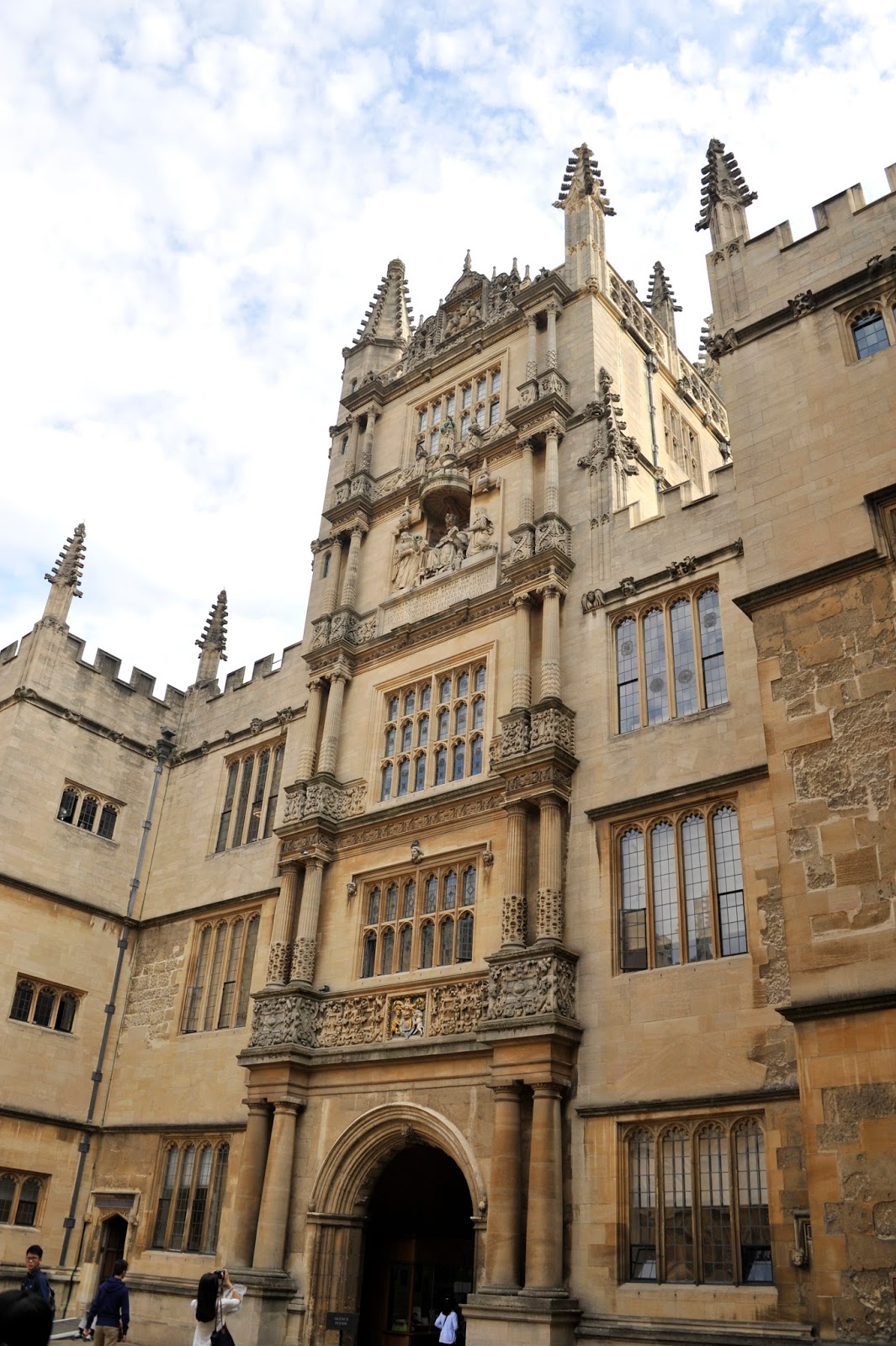
Today Tony took us to Oxford to see several museums there. We visited Pitt Rivers Museum, Museum of History of Science and Modern Art Oxford. We also walked around the place which has been chosen for shooting the film Harry Potter.

It was my first time to visit Oxford. Most of the buildings there are old and beautiful. I could feel the history of Oxford from the buildings.

The Pitt River Museum is the biggest museum which has collected different archaeology and anthropology things from different periods and countries. I think no matter what you learn about design, you always can get inspiration from this museum. There are so many fantastic collections for different types like jewelry, textiles, buildings and many different patterns on potteries, drums, weapons and so on. 
The interior of this museum is different other classical interior in Britain. It was made by metal and glass because of the industry evolution in that era.
I like this model because it was made by different materials. My final project also needs different materials combination in special way, not just stick on the structure.
The way of showing the collections is different from other museums. The catalogs depends on the function. You can contrast directly the different countries and periods collection in one showcase. My final project also want to show people the differences between old and new, so the way of the collection in this museum really give me some good ideas.

Because of the limited time, we didn't have much time to visit different interesting places. But the architecture in Oxford really impressed me and I want to do more deep research on it. 


2013年8月20日星期二

Tony's and Geoffry's Projects

Last week we finished the projects of  Tony and Geoff. Tony' s project was about collection and Geoff's was about the mystic Camberwell. We had a small exhibition of our projects and we shared the different ideas and concepts about our projects.
This is my Geoff's project. When I walked in the Nunhead Cemetery, the difference between the old and new tombstones impressed me very much. Most of the old tombstones were built in the Victorian era. They were stately and fine carving. The new tombstones, which were built in recent years, were more creative and make people who see them feel warm. Because my MA project is to research the old building reconstruction, I want to do this project related to my MA project. I think it is interesting to put the old and new together to contrast the differences between them so that we can see the characteristics of different eras. I use the wood as basic materials to make models of the old and new tombstones. The original materials for old tombstones were more natural and for new tombstones may be more colourful and various. So I keep the natural wood colour for the old tombstones and pain colours or use other materials for the new tombstones.
The work has many possibilities. The models show quite many differences between old and new directly. Contrasting the old and new can help me to think more about my MA project. Not only the architectures have differences between old and new, there were many smaller and more detailed subjects can show the differences. Finding the story behind these old and new tombstones is also interesting. If I have more time to deal with the project, I will make a bigger and finer tombstone that can clearly show the characteristic of the Victorian style. I can add the modern elements to the old tombstone model. In this way, I can not only contrast the differences also make a totally new style of tombstones. 

This is my collection project. I took many pictures about the details of old buildings in China and London. Different culture make the architecture different. Contrasting the details of Chinese and British architecture is quite interesting for me to learn the architecture history better. Tony suggested me the idea about house of cards of Charles and Ray Eames. I did some changes in the way of setting up the cards. I treated the house of cards as a building and put the different parts of details of buildings from the bottom to top on the cardboard based on what roles they play in the building, like doors, windows and roofs. There were also some details inside the building like stairs, ceilings and pillars and I cut a window on the model for people can see the inside details.
Actually I want to deepen the idea of this model in my final project. Making a structure to put the elements of old and new. The book I bought about Sou Fujimoto Futurospective Architecture really helps me to think about what the structure of the model can be. I also want to use the window concept in the final project. Like the idea on the book, in the Tate Britain and on my collection project.

I really liked Mia's collection project. She took pictures of people in tubes or stations. The way she put the pictures was interesting. She put the different parts of people's body pictures in three shelves and she also drew something to act in concern with the pictures. Like many flowers growing on  a woman's head and a hat wearing on a man's head. I like this idea and I am thinking of put this idea of using different medias in my final project. I can draw or take some pictures that can help me to show my idea more clear and make the image combine with my model.


Workshop 3: create my virtual museum (Ver.3)


In this essay I will discuss ideas in regards to the relationship between old and new building in modern environments. Using case studies, I will show the differences between the western culture of preserving and utilizing the old heritage in contrast replacing the old buildings with modern in China.

During my four years of study at China Academy of Art, I have learned that interior design is not simply about deciding how we arrange the furniture, but taking into consideration the people that inhabit this place, past memories of this place and the identity of it. More specifically I have been most interested in the idea of reusing and reconstructing of historical sites and old elements within the city. Thus I have done several projects that relate to old buildings. For example, reconstructing abandoned building and re-planning old block which was also my graduation project. Blow you can see the examples of it.
My graduation project was a challenge to me which related to urban planning. We worked as a 4-people-group. This project is to design and plan a cultural and commercial block in Beijing. It is a real project that our tutor's work team is doing. This block will have shopping malls, hotel, museums and cultural communication center. Even though the design might seem utopian and difficult to put in practice, we tried to combine our design with the traditional function and culture and linked it with the preexisting memories of this place. This project further development my ideas about the old buildings reconstruction.

With the technological and economical development of the modern society, building excessively is constantly reducing the already limited space in cities. For that some architects who pay attention to environment and culture in China see the value of reusing, protecting and repurposing the old buildings. (
Y. Chang, 2010; S. Liang, 2011; S. Wang, 2012) The old buildings not only are the historical protected buildings, but also are the normal, less value and less protected old buildings. In my opinion, cities need old buildings. 
Peter Eisenman said:
                        My work is a constant process of uncovering. Do not forget, there is no new history. The architects I 
                         am going back to are all still there. They do not move. I move.[1]
Also the famous Japanese architect Tadao Ando said:
                        You cannot simply put something new into a place. You have to absorb what you see around you, what 
                        exists on the land, and then use that knowledge along with contemporary thinking to interpret what you 
                        see.[1]
It is important to return the cultural memory of the city and keep it alive for its people. Besides some degree of protection for the old buildings and districts, the old buildings also need revising, updating or modernizing. Reconstructing the old buildings can be done in many ways as soon as we keep their former characters. 

Despite of the Chinese architects attempt the ideas, however in China there is still a big problem since the old buildings are not being appreciated both by governments and the Chinese people and they end up to be abandoned or replaced by modern ones. There is general belief that the financial development equals modern western buildings. Governments build modern buildings which will translate to financial development and remove large area of old buildings. The ways what governments do make the people think less about the old buildings heritage. (W. Chang, J. Xue, 2011;Y. Yang, 2012) Many old blocks became out of use even totally abandon because of less attention and managing from people. On the other hand, old buildings are get much more attention in London. Most of the old buildings still have different function today. 
London itself just likes a big library of architecture history. When you walk in a street in London, you strongly fell the English culture through the architectures. You can see many historical details in the buildings, you can live or work in them and enjoy their strong cultural feeling while they, at the same time, have the modern life. People in London enjoy and appreciate living in old buildings while Chinese people do not see the value of it. 
This old block in China became totally abandoned after reconstructing failed.  All the shops closed during the working hours.
In London, we can see the old block with new functions still be alive nowadays.

In the following sections I will review some case studies were old buildings have been reconstructed and repurposed in the western countries. For instance, the Italian architect name Gae Aulenti turned an old train station in Paris into one of the best art museums
Musée d’Orsay
She connected the building with the environment of city and did full use of the original features of the building. In her design, she maintained the original museum's construction. At the same time, she took into consideration the relationship  between the building and the cityscape. Aulenti views architecture as a concrete, untouchable entity that uses the city as its form generator. She sees architecture in terms of its relationship to the urban environment. In her designs, she blends the private with the public to generate architectural forms and spatial relationships. Aulenti believes that to create an effective domestic environment, architects must maintain the spatial elements and attributes that exist within a city. Accordingly, she attempts to design buildings in such a way that they share the complexity and density that exists within an urban atmosphere.(http://www.archiplanet.org/wiki/Gae_Aulenti, 08/2013) 

British Museum
Norman Foster said:
As an architect you design for the present, with an awareness of the past, for a future which is 
essentially unknown.[2]
The central courtyard of British Museum became out of use once upon a time. Norman Foster preserved the round reading hall of the former British Library and redesigned the roof in using similar curves and glass to create a light space. He therefore took into consideration how the modern roof would integrate with the old elements of the round reading hall. The shapes of the pieces of glass are all different from each other because of the design of curving roof.


Wiltons
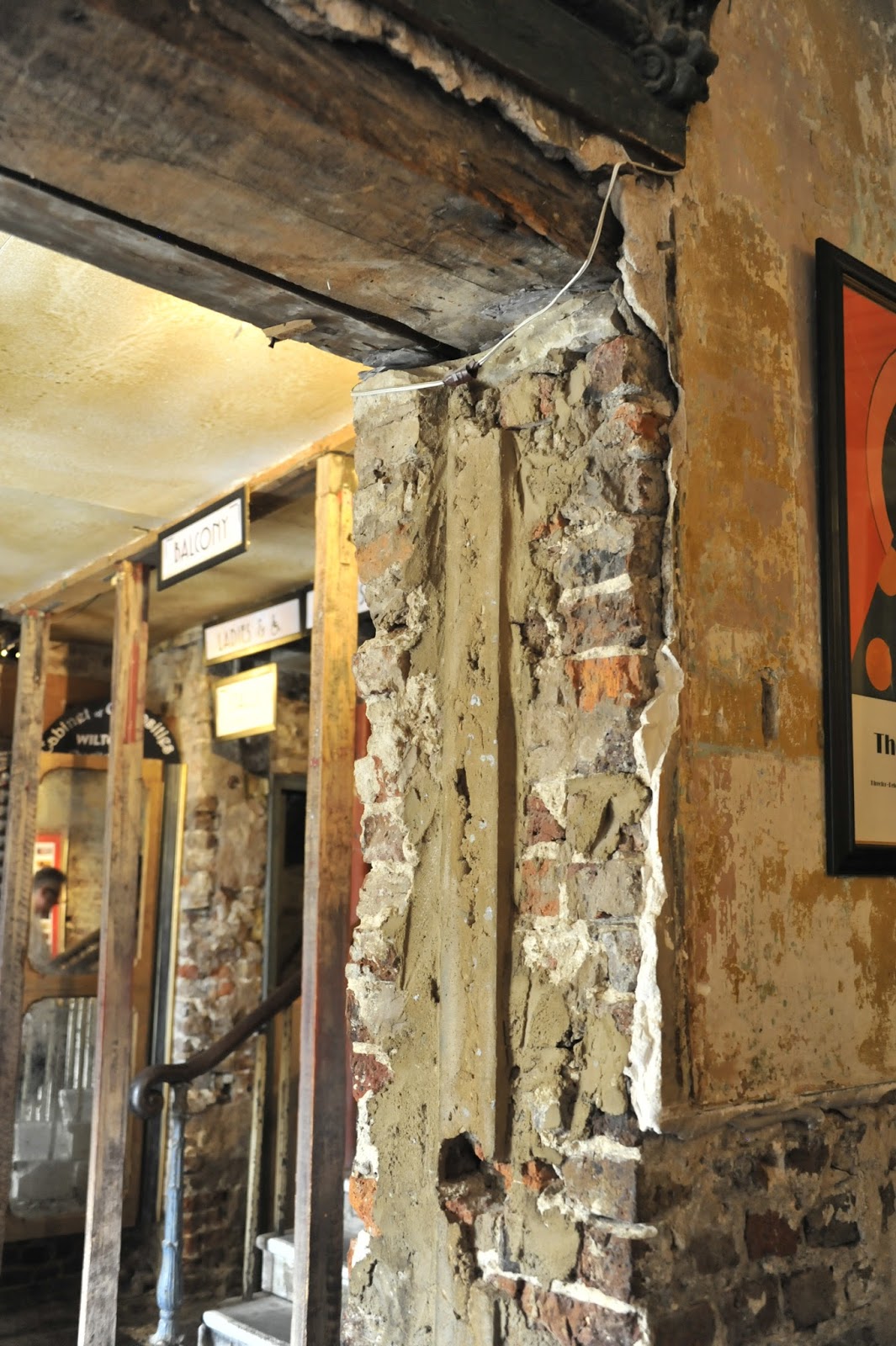
The Wiltons Music Hall is a unique building comprising a mid-19th Century grand music hall attached to an 18th Century terrace of three houses and a pub. It was old but it had the special feel of nostalgia that made you feel comfortable when people were inside. The details of this house was old or made to be looked like old, like the stairs, the different types of furniture, the piano, the lights, even the bricks on the walls were broken, they are still beautiful. "This is the most important surviving early music hall to be seen anywhere......It is of outstanding architectural and archaeological significance." The Theatres Trust.


Chelsea College of Art and Design
The college that I am going to learn is also an example for reusing the old building. It was once called the name 45 Millbank, dates back to the 1700s. That mill was replaced around 1736 with a house for Sir Robert Grosvenor, demolished in 1809. The site was next occupied by the greatest prison in Europe, the Millbank Penitentiary. Closed in the late 1800s, the prison was demolished for the building of the Royal Army Medical College and Regimental Mess. Today, this impressive Edwardian edifice is home to the Chelsea College of Art and Design - and to 45 Millbank. Chelsea opened a new public gallery where visitors to the campus can see cutting edge art and design. Joint events are also staged with Tate Britain, which is next to Chelsea College. The developing relationship of these two great art institutions gives London an exciting cultural centre on Millbank. (http://45millbank.com/site-history, 08/2013)

Xintiandi·Shanghai
China has a famous successful case about reconstructing old buildings. It is called Xintiandi. It is a walking street gathering dinning, business, entertainment and culture based on the old buildings of the original style of Shanghai Shikumen. The appearance of buildings has not changed from the style of Shikumen, but the interior of the buildings became completely modern lifestyle. Xintiandi combines the modern function with the old Chinese buildings closely, shows the history of architecture in Shanghai. Now it has become one of the landmarks in Shanghai. (S. He, F. Wu, 2005)

Buildings have lives and voice that are worth listening to. (Littlefield, Lewis, 2007) Cities need old buildings. Reusing the old buildings should be paid more attention. For the practical element of workshop 3 I have to create a virtual museum that would bring together my work with the work of other artists and theorists that think about the same idea.

In my MA project I aim to further investigate the relationship of old and new buildings and think of ways that this culture of appreciating them can be applied in China. I will read a lot of books about old and new architecture to help me to understand better about the meaning of old buildings reconstruction. I collect a list of the bibliography that can help me to learn.
-       Architecture Reborn: The Conversion and Reconstruction of Old Buildings
-       Re/architecture: old buildings/ new uses
-       Down to Earth: Mud Architecture – An Old Idea, A New Future
-       Metaobolism, The City of Future: [dreams and visions of reconstruction in post war and present-day, Japan]
-       Re-forming British: Narratives of Modernity Before Reconstruction
-       Idea and Style; The Quest for Modern Architecture
-       Space In architecture: The Evolution of A New Idea In The Theory and History of The Modern Movements
-       When Culture Meets Architecture
-       Architecture Culture, 1943-1968: A Documentary Anthology
Besides, I will collect and analyze famous architects’ work in the world. I may do research from the material, structure, cultural style or other respects of the old buildings. I can collect different details of old architecture in London as much as I can, compare with the details in China. The architecture is different because of the different culture, so the ways of old buildings reconstruction do. I am willing to see and learn different ideas and ways of old buildings reconstruction. The MA project for me may not be a complete project for buildings. It can be presented with a space made by different old and new materials to show the combination of old and new, to find the best method of performing the old space in modern ways.


References:

[1] L.S. Dushkes. The Architect Says: Quotes, Quips, and Words of Wisdom (2012). Princeton Architectural Press.
S. Cantacuzino. Re-Architecture: Old Buildings New Uses (1989). Abbeville Pr.
K. Powell. Architecture Reborn: The Conversion and Reconstruction of Old Buildings (2005). New Line Books.
R. Klanten, L. Feireiss. Build-on: Converted Architecture and Transformed Buildings (2009). Die Gestalten Verlag.
Y. Chang, 2012. Materialism (2010). http://video.zhulong.com/play708789.html (08/2013).
S. Liang. Chinese Architecture Art and Artifacts (2011). Foreign Language Teaching and Research Press.
S. Wang. The Architect who is anti-modernization (March 15th, 2012). Time Weekly.
W. Chang, J. Xue. (2011) Study Situation of Chinese Contemporary Architectural Design. Journal of Modern Enterprise Education, 17, 25.
Y. Yang. The Deformity Status of Chinese Architecture (May 23rd, 2012). People Digest.
[2] N. Foster. My Green Agenda for Architecture (2007). TED Talks.
S. He, F. Wu. (2005) Property-led redevelopment in post-reform China: a case study of Xintiandi redevelopment project in Shanghai. Journal of Urban Affairs, 27, (1), 1-23.
D. Littlefield, S. Lewis. Architectural Voices (2007) Wiley-Academy.